Cheap Hosting vs. Total Cost of Ownership: What That $2/Month Plan Actually Costs You
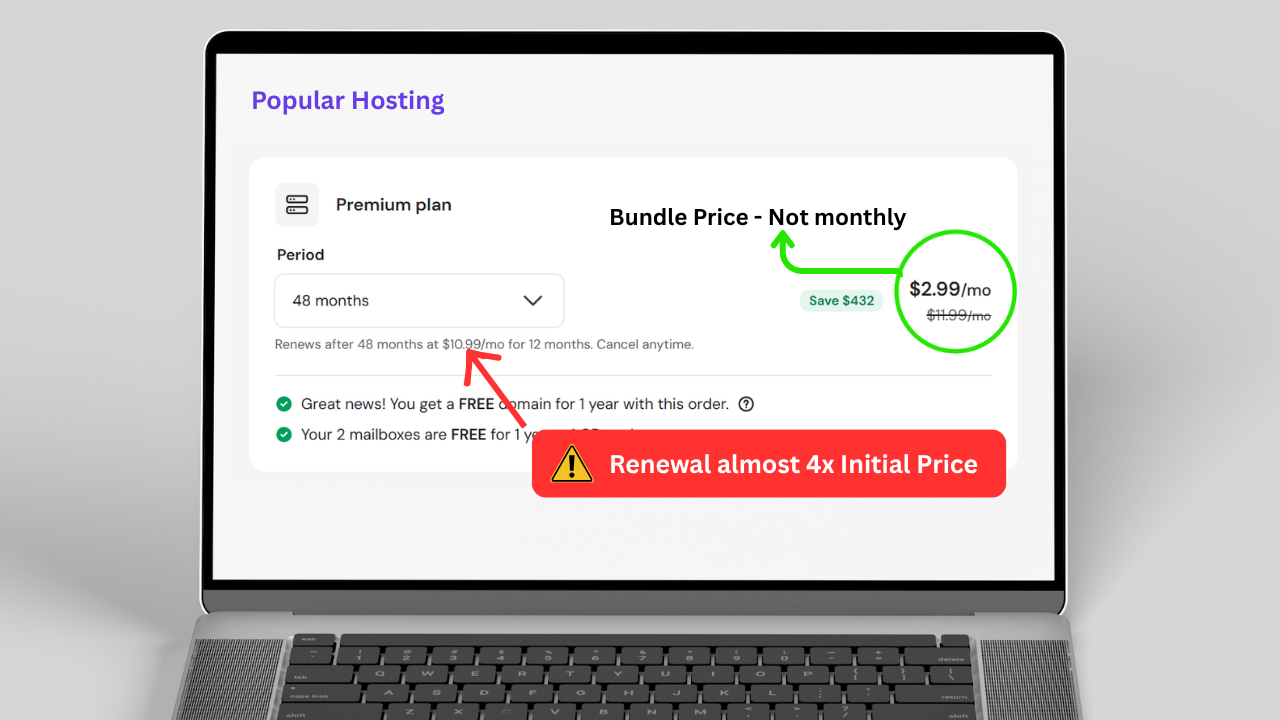
Let's be honest about something most hosting companies won't say out loud: the price on the homepage is not the price you end up paying. You've probably seen it yourself, either as a customer or watching a friend get burned. A plan advertised at $2 a month looks unbeatable, until the renewal invoice shows up at $10 a month and you realize the "deal" only ever applied to year one.
This isn't really about being tricked. It's about a pricing model that's built around one number — the sign-up price — while the real cost of running a website lives somewhere else entirely: uptime, support response time, security, and how much of your own time you burn fixing things that should just work.
What "Total Cost of Ownership" Actually Means Here
TCO isn't a finance term you need a spreadsheet for. For hosting, it just means: what does this plan cost you once you add up everything beyond the sticker price?
That includes:
1. The renewal price, not the intro price.
2. Add-ons that used to be "extra" but are now table stakes — SSL certificates, backups, malware scanning.
3. Downtime. If your site goes down during a sale or a client demo, that has a real dollar cost.
4. Your own time. Four hours in a support queue is four hours you didn't spend on your actual work.
Once you add those up, a lot of "cheap" hosting stops looking cheap.
Why This Matters More in 2026 Than It Used To
Hosting has quietly turned into something bigger than "server space." Customers today expect security scanning, easy backup and restore options, and real uptime guarantees as standard, not as upsells. Providers that still compete purely on the lowest sign-up price are increasingly the ones cutting corners somewhere else to make that price work.
That's part of why the industry itself is shifting. Hosting companies are moving away from pure price competition and toward speed, security, and support as the things that actually keep customers around. If the providers themselves are admitting price alone doesn't win long-term, that's a signal worth paying attention to as a buyer too.
A Simple Way to Check What You're Really Paying
Before you sign up for (or renew) any hosting plan, pull up the pricing page and check the renewal rate, not just the promo rate. Most providers list it in small print. You can also just check your own site's response time from the command line to get a feel for where your current host stands:
curl -o /dev/null -s -w "Time to first byte: %{time_starttransfer}s\n" https://yourwebsite.com
If that number is creeping past a second or two, or your renewal price has quietly doubled, it's worth shopping around — not out of impulse, but because the "cheap" option may no longer be cheap at all.
Signs You're Already Paying the Hidden Cost
A few patterns are easy to spot once you know to look for them:
Your site has gone down more than once this year and support took hours to respond. You're paying separately for SSL, backups, or security scanning that other hosts bundle in. Your renewal invoice was noticeably higher than what you signed up for. You've had to scramble for a backup because your host didn't give you an easy way to grab one yourself, or restore it, before something broke.
Any one of these on its own isn't a huge deal. All of them together usually means the plan is costing more than it looks like on paper.
What to Look for Instead
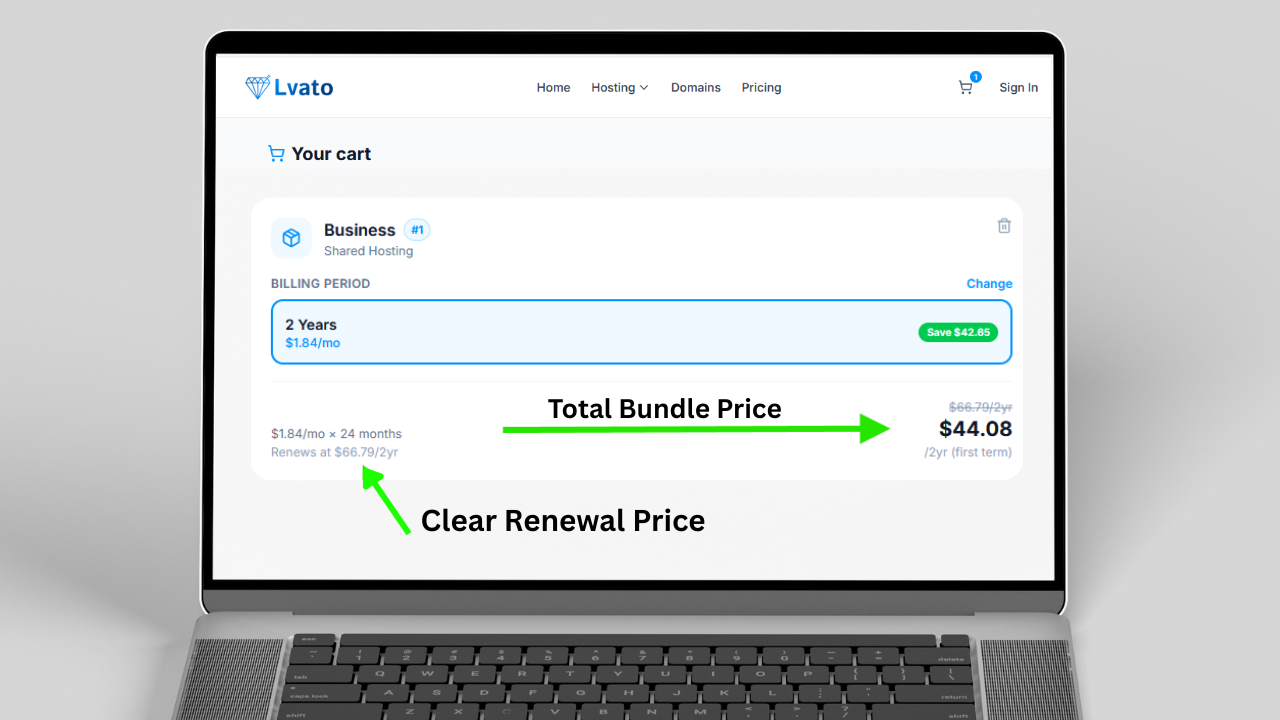
Here's the part most hosting companies skip: almost every provider raises prices on renewal, including us. The difference is whether that increase is disclosed upfront and kept reasonable, or buried until the invoice lands. A 10–30% renewal increase that's shown to you clearly, for every billing cycle, before you sign up is a completely different experience than a $2 plan that quietly jumps to $10 a month.
The fix isn't necessarily "spend more." It's spend on the right things, with full visibility into what each term actually costs. A good plan should include free SSL by default, a backup tool that lets you take, download, and restore backups whenever you want, real uptime guarantees (99.9% is the current baseline, not a bonus), and support that responds in minutes, not days.
That's the model we've built Lvato around: every billing cycle — monthly, annual, multi-year — shows its renewal price clearly at checkout, so you can compare and pick the term that makes the most financial sense for you, rather than discovering the real number later. SSL, backups, and support are included rather than upsold. It won't always be the single cheapest number on a comparison chart, and that's kind of the point — it's priced to reflect what it actually costs to run a website well, with no surprises at renewal.
The Bottom Line
Cheap hosting isn't inherently a bad deal. Cheap hosting that hides its real cost until renewal, or that skips security and support to hit a low price, is the bad deal. Before your next renewal, do the math on what you're actually paying — sign-up price, renewal price, add-ons, and your own time. That number tells you far more than the banner ad ever will.